Flying ANA Business Class — Because Economy Cost More Miles
ANA (All Nippon Airways) isn’t on the same level of luxury as the Singapore Suites Class I wrote about a year earlier. But the service was excellent, and the way I ended up booking it is the kind of points-and-miles quirk that’s worth understanding.
The Booking Trick
I wasn’t planning to fly business. I was planning the trip three days before departure, looking at award redemptions, when I noticed something strange: the miles required for an economy seat were higher than the business class seat.
That’s not a typo. ANA’s award chart had a quirk — or there was a sale, or some pricing oddity that day — and it would have cost me more miles to fly economy than business. So obviously, I went business.
The route was the standard ANA Jakarta routing: a long-haul transpacific leg, transit through Narita, and a second leg down to CGK (Soekarno-Hatta) in Jakarta. About 24 hours total including the layover.
Settling In
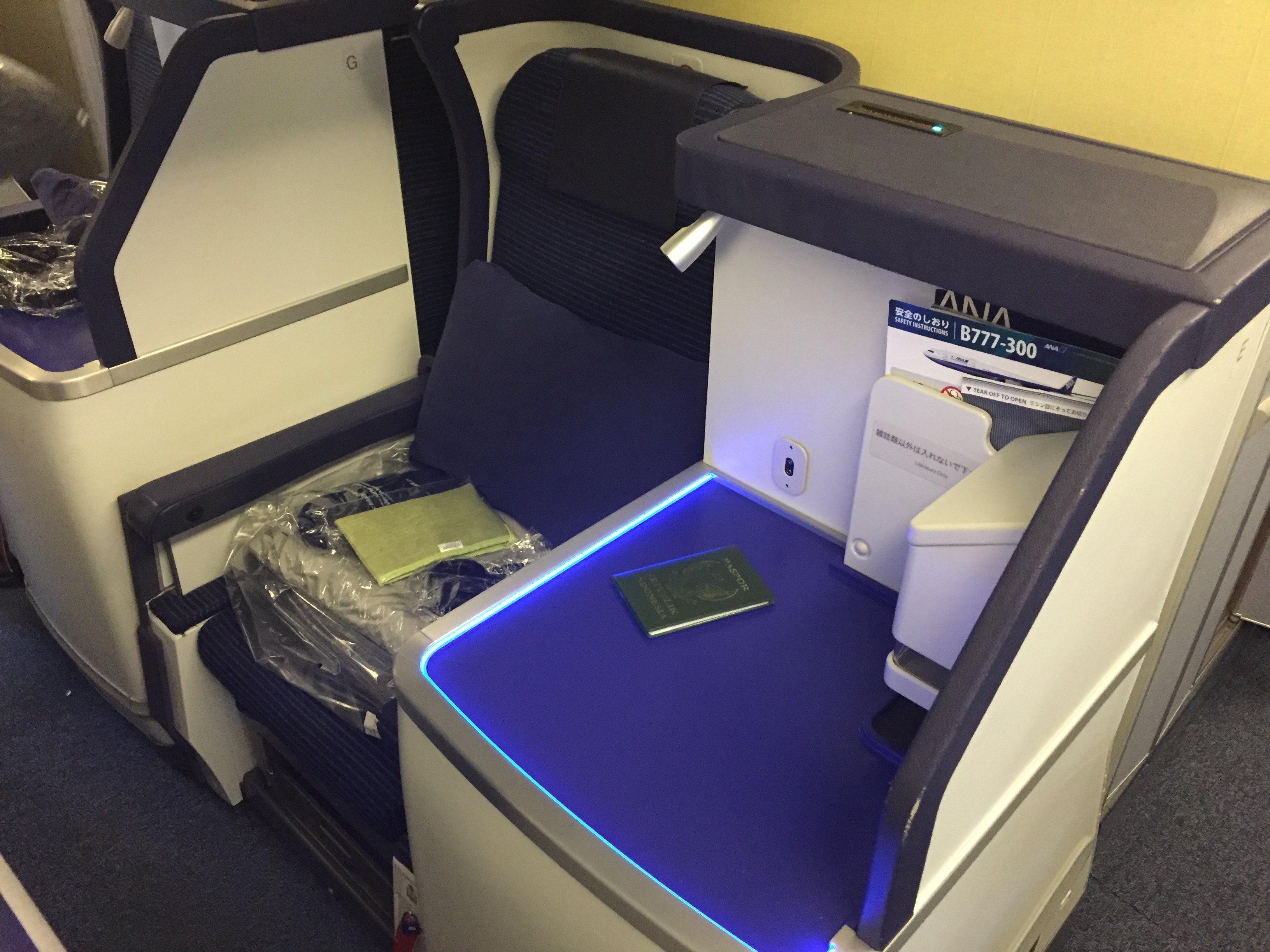
The aircraft was a Boeing 777-300. The seat is bigger than economy and converts into a fully flat bed. There’s a side console with a desk surface for putting drinks and reading material, plus storage compartments and a personal IFE screen. Not the personal-suite experience of Singapore — no door, no separation from the aisle — but a proper business class seat that you can sleep in for a long-haul.
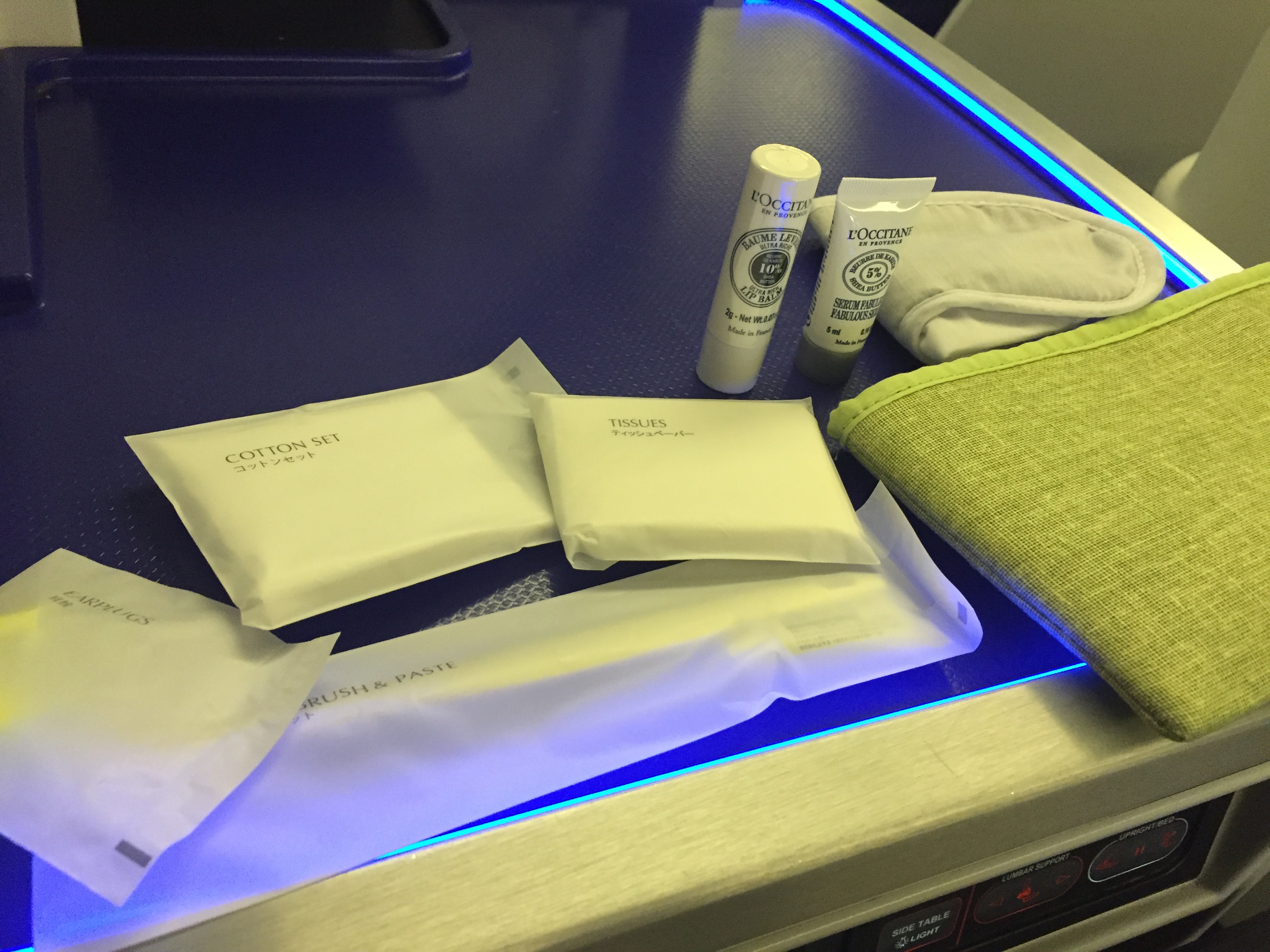
The amenity kit comes with toiletries from L’Occitane — lip balm, face serum, eye mask, cotton set, tissues, the works. Genuinely useful on a 24+ hour journey. By hour 18, your skin starts feeling like sandpaper, and you’ll be glad someone packed actual moisturiser.
Lunch Service
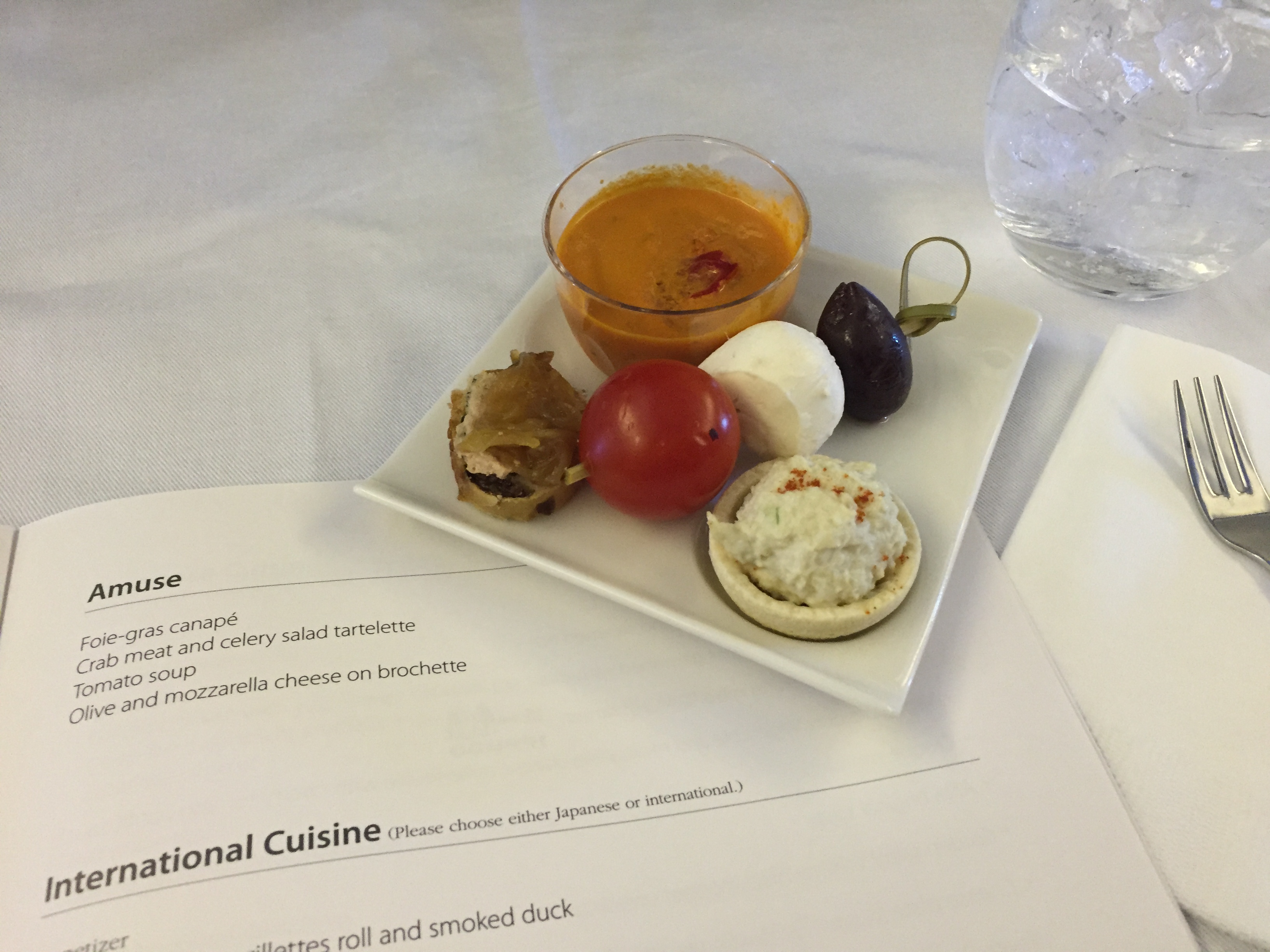
The first thing they brought after take-off was the amuse plate — five little bites to set the tone. Foie gras canapé, a shot of tomato soup, a crab and celery tartelette, a tomato-marinated mozzarella ball, and an olive on a stick. Light, balanced, and the kind of thing that signals you’re in for a real meal, not a tray of reheated chicken.
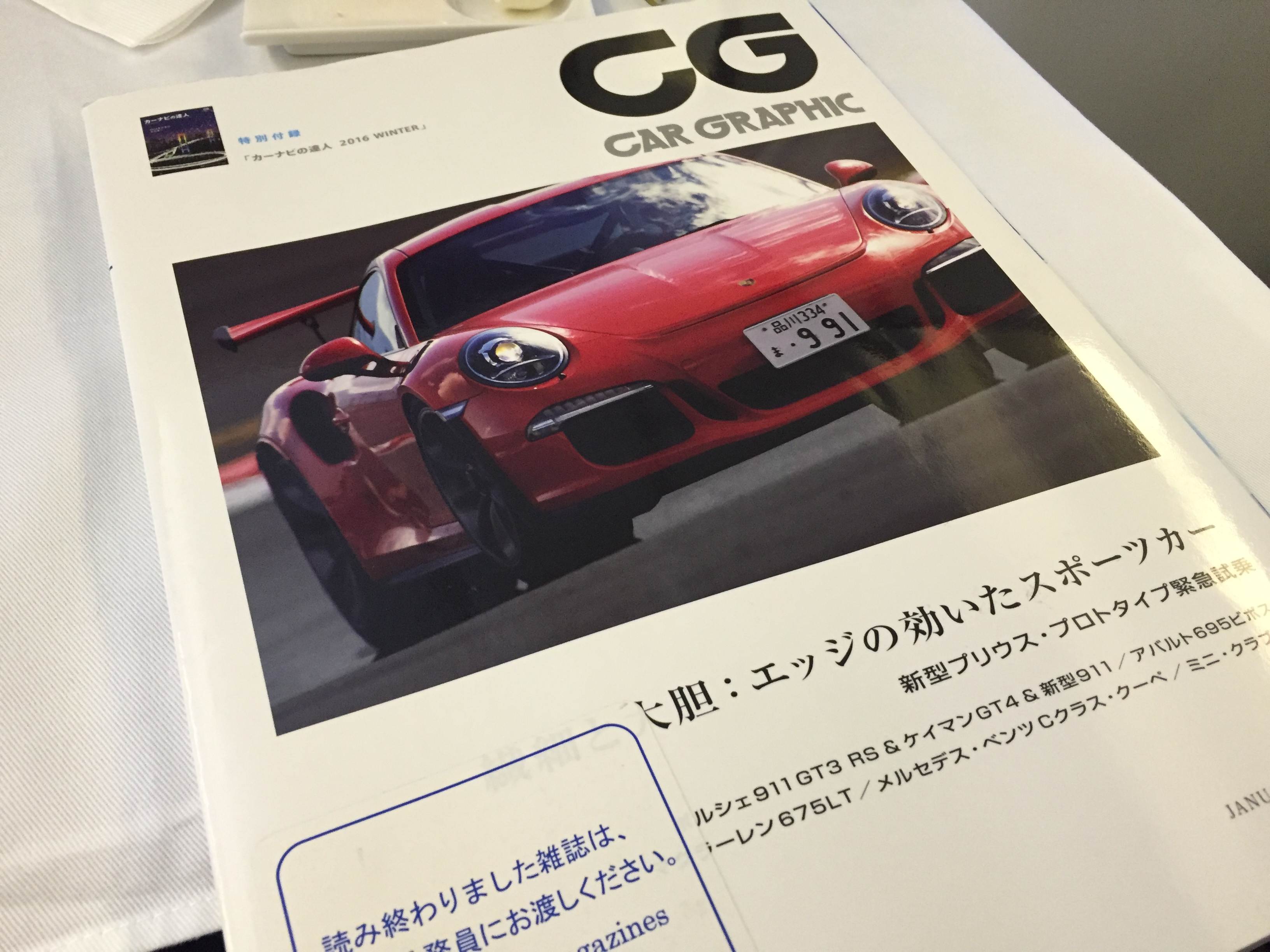
While the food was being plated, I asked the stewardess if they had any car magazines. She came back ten minutes later with the latest issue of CAR GRAPHIC — a Japanese magazine with a Porsche 911 on the cover. That’s the kind of small thing that tells you a lot about ANA’s service philosophy. They didn’t have it on the trolley, so she went and found one.
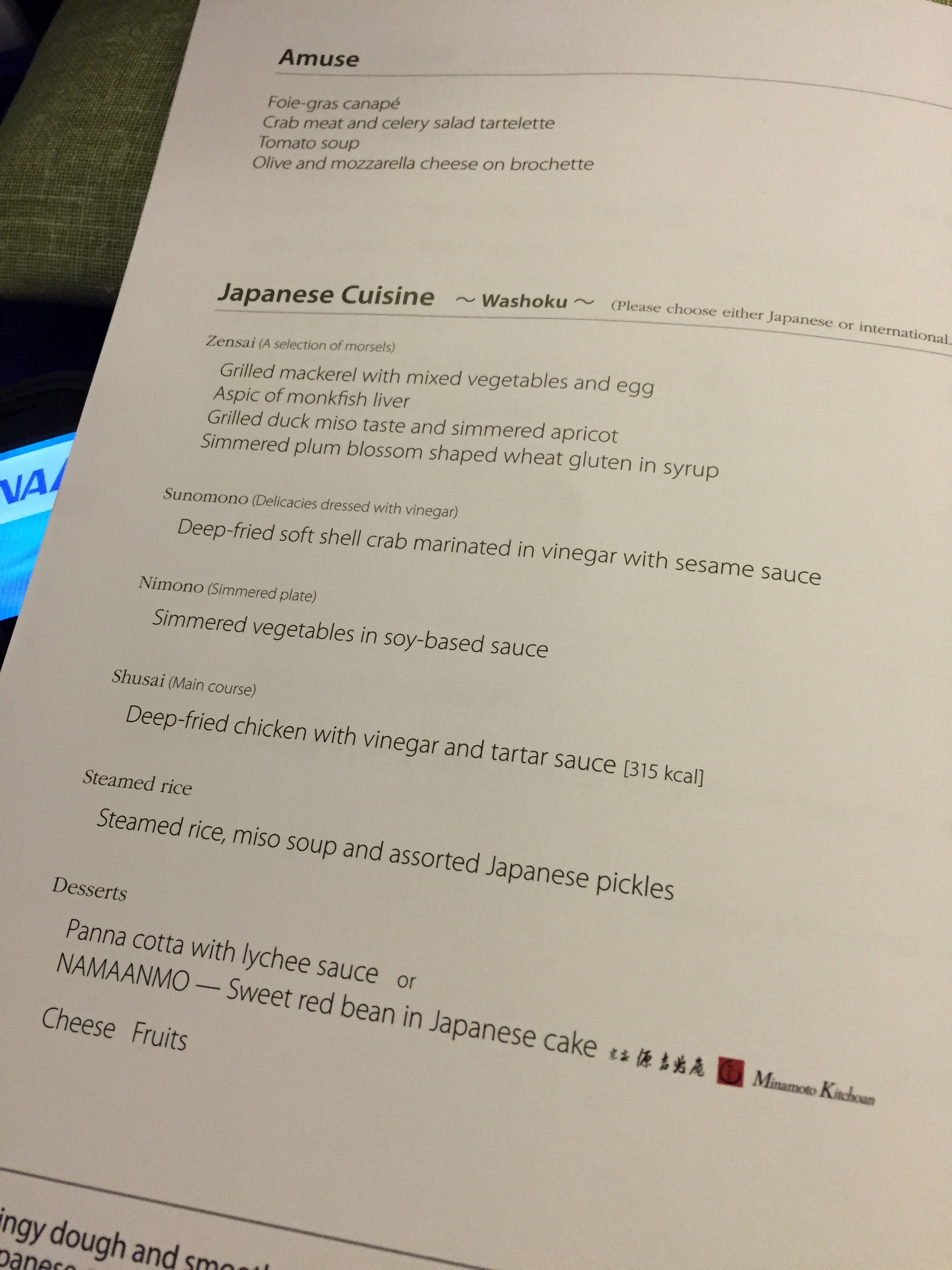
ANA gives you a printed menu with two options: Japanese (Washoku) or International. Always pick Japanese on a Japanese carrier. They do it better than the international option, and you’ll never get this version of these dishes anywhere else. The menu reads like a kaiseki: amuse, zensai, sunomono, nimono, shusai, rice, dessert.
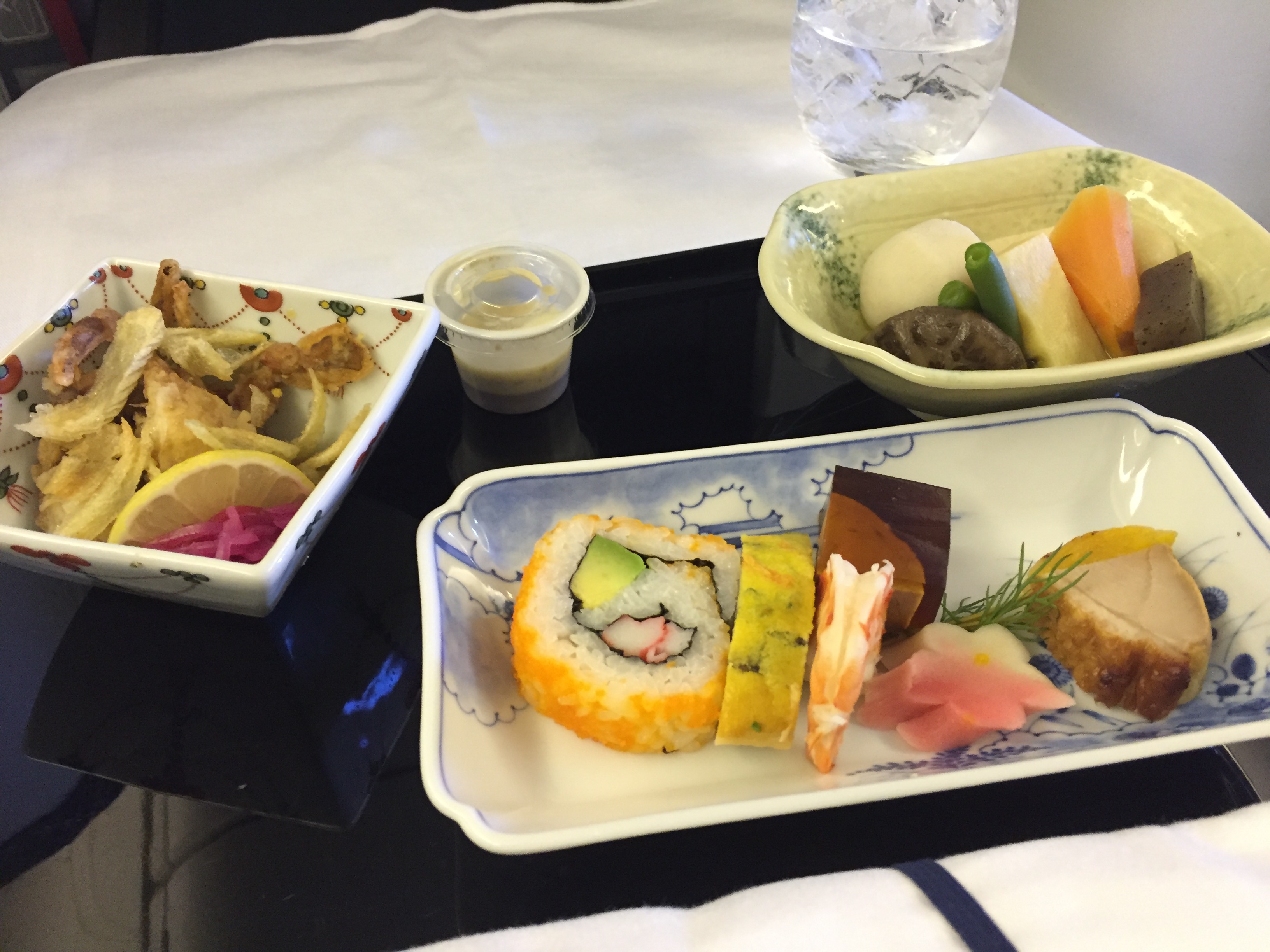
The zensai arrived as a beautiful tray — a section of sushi roll, slices of tamagoyaki, a piece of duck miso, simmered plum-blossom-shaped wheat gluten, and on the side, a small bowl of deep-fried soft shell crab and a dish of simmered vegetables. Each piece tasted distinct, and the presentation was a step above what you’d expect from any aircraft kitchen.
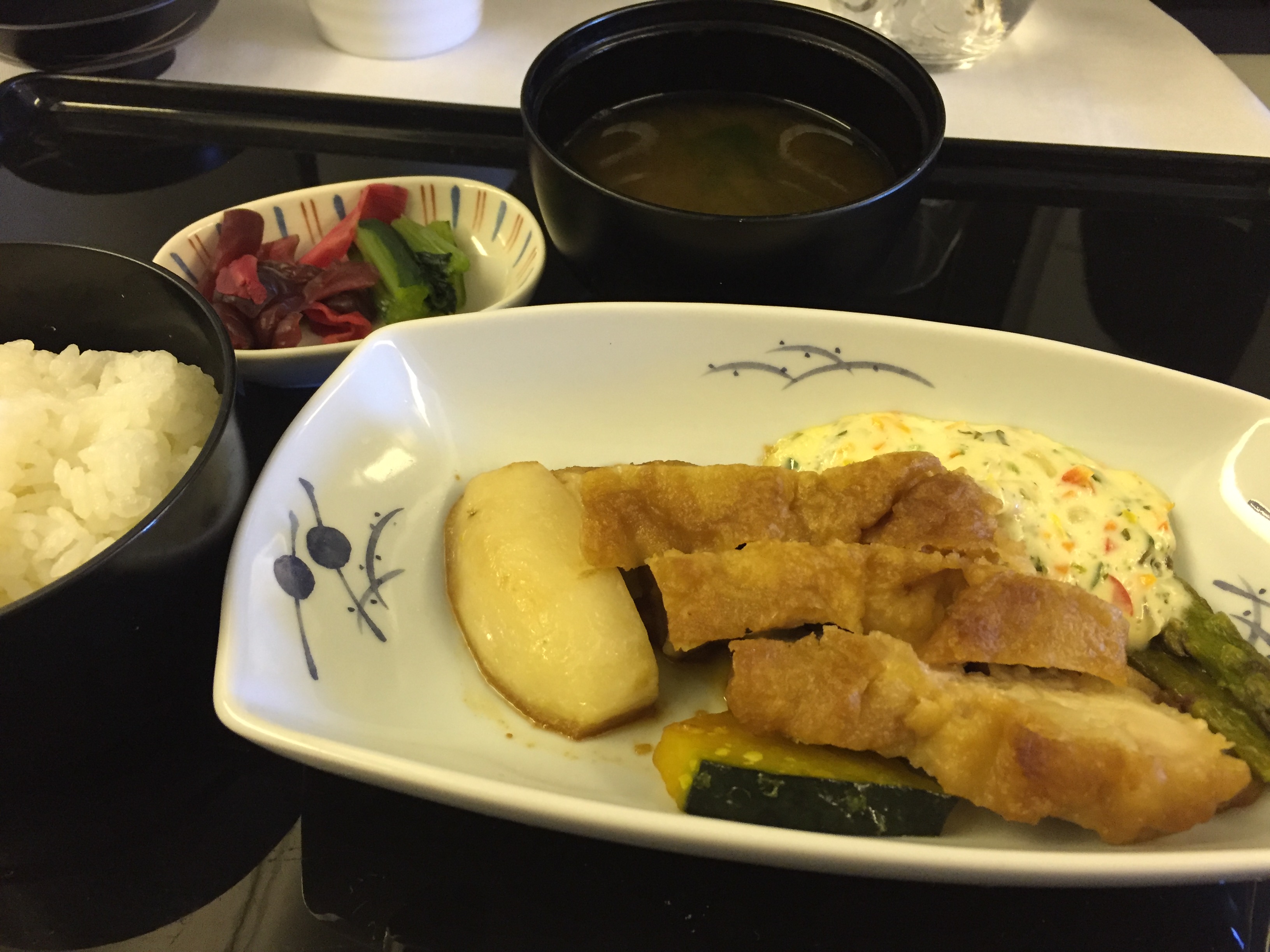
The shusai (main course) was deep-fried chicken with vinegar and tartar sauce, served with steamed rice, miso soup with mushrooms, and pickled vegetables. Crispy outside, juicy inside. The tartar sauce was loaded with chopped pickles and vegetables — bright and sharp against the richness of the chicken. This is the dish that surprised me most. It tasted like something out of a proper restaurant.
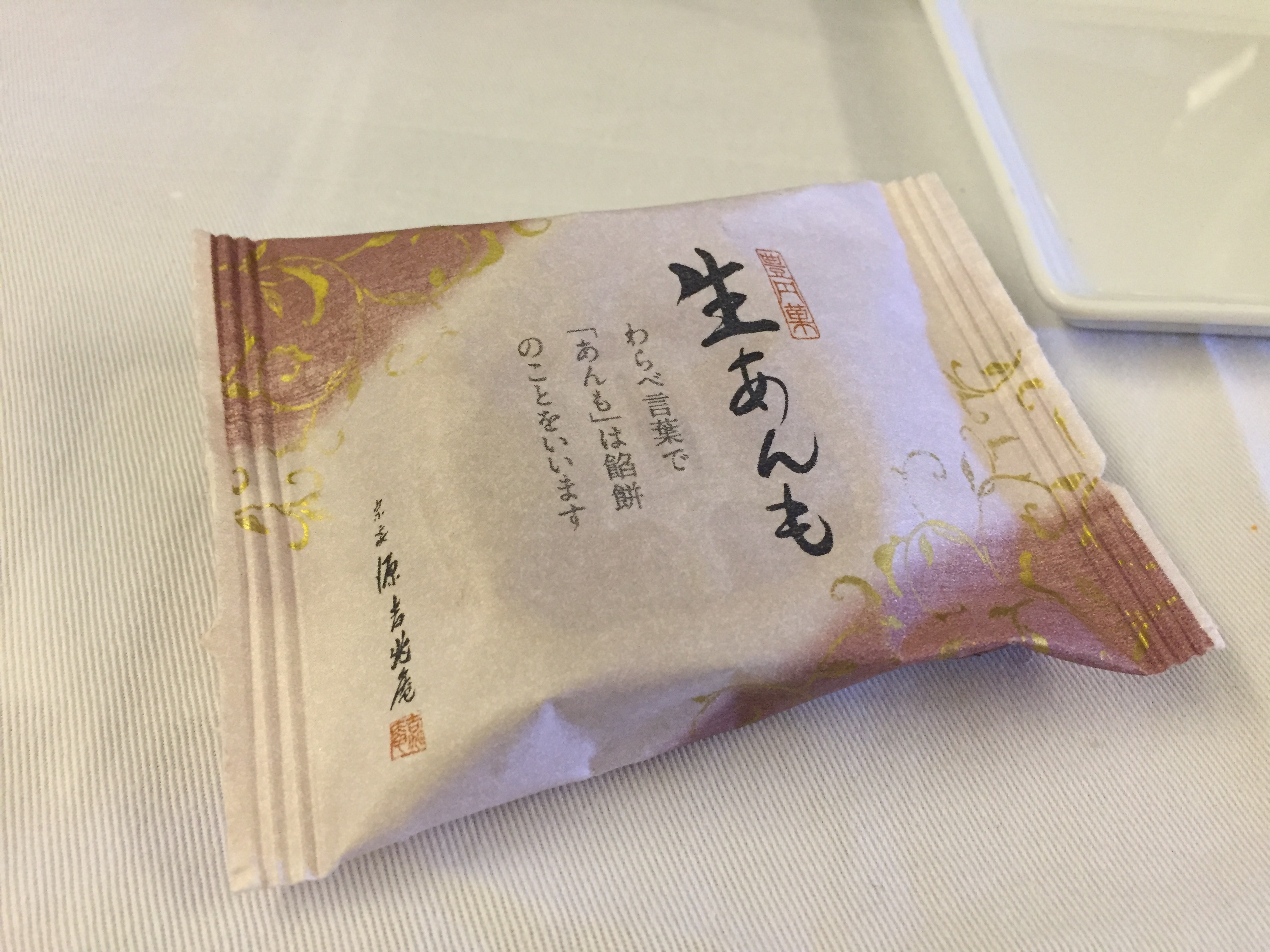
For dessert there was a choice between panna cotta with lychee sauce or NAMAANMO — a fresh red bean mochi from Minamoto Kitchoan, a famous Japanese confectionery house. I picked the mochi.
It was excellent. Soft, slightly chewy outer dough, with a sweet anko centre that wasn’t cloying. Better than most desserts I’ve had on the ground.
The Snack Marathon
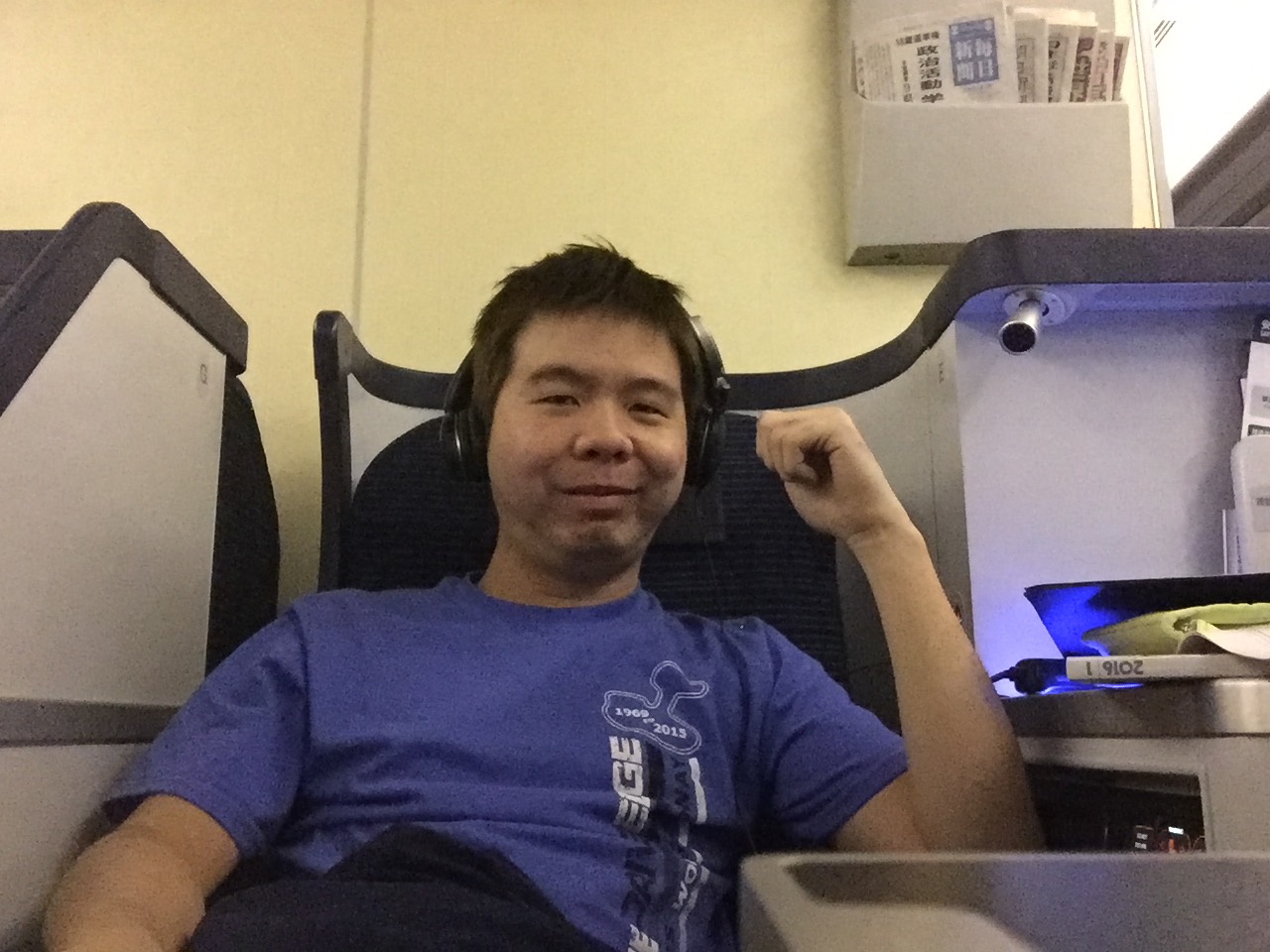
Fully fed and reclining. Bose noise-cancelling headphones, blue light glowing under the seat, ready for the long stretch. This is the moment in a long-haul flight where you tell yourself you’ll watch one movie and then sleep. Spoiler: I did not sleep.
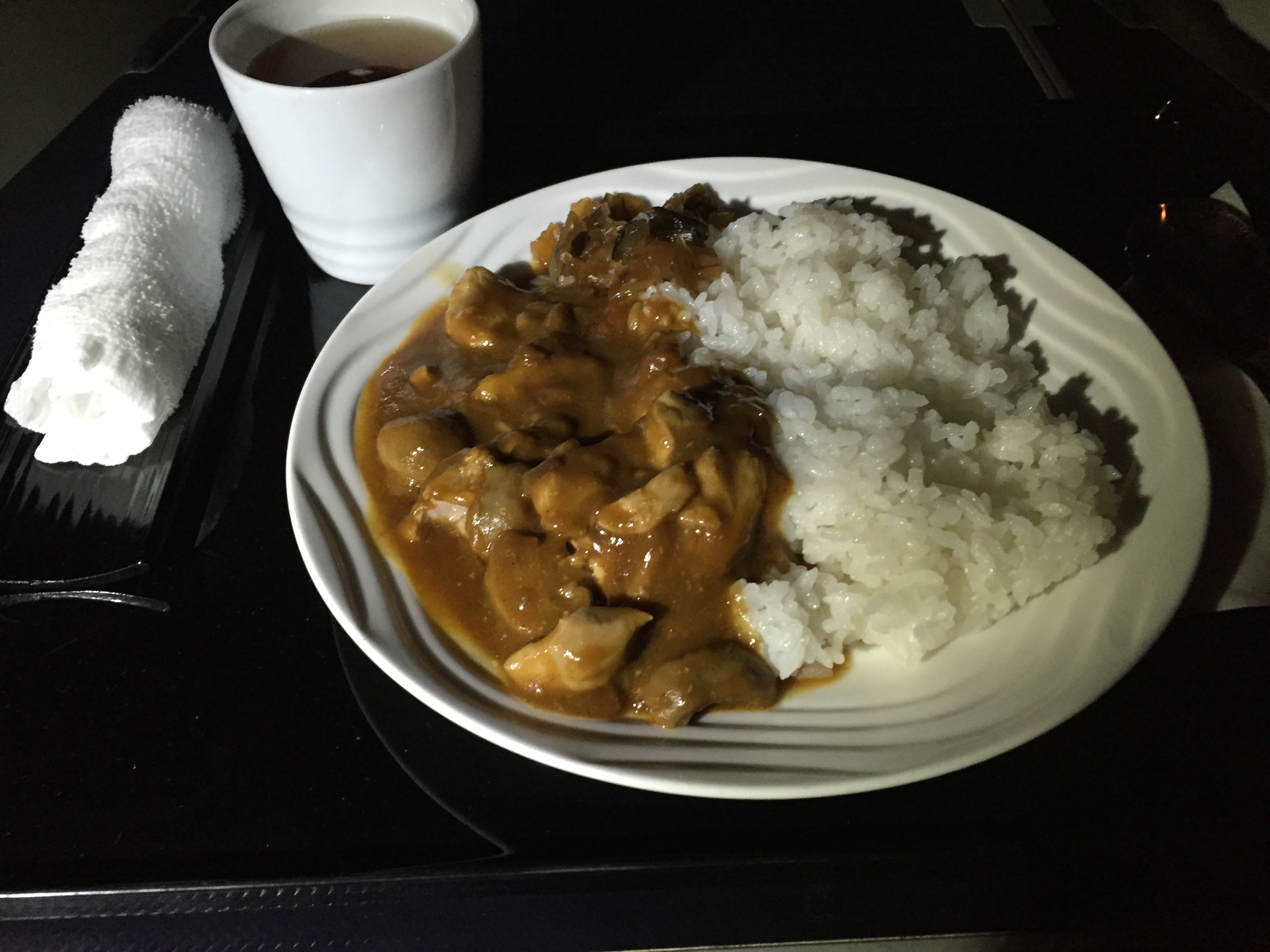
Instead, I ate. ANA’s between-meals menu is no joke. First up was Japanese curry with rice — and ANA’s curry is famously good. They’ve actually sold their in-flight curry as a retail product in Japan. Rich, mildly spiced, with tender chunks of chicken. A second wind in carb form.
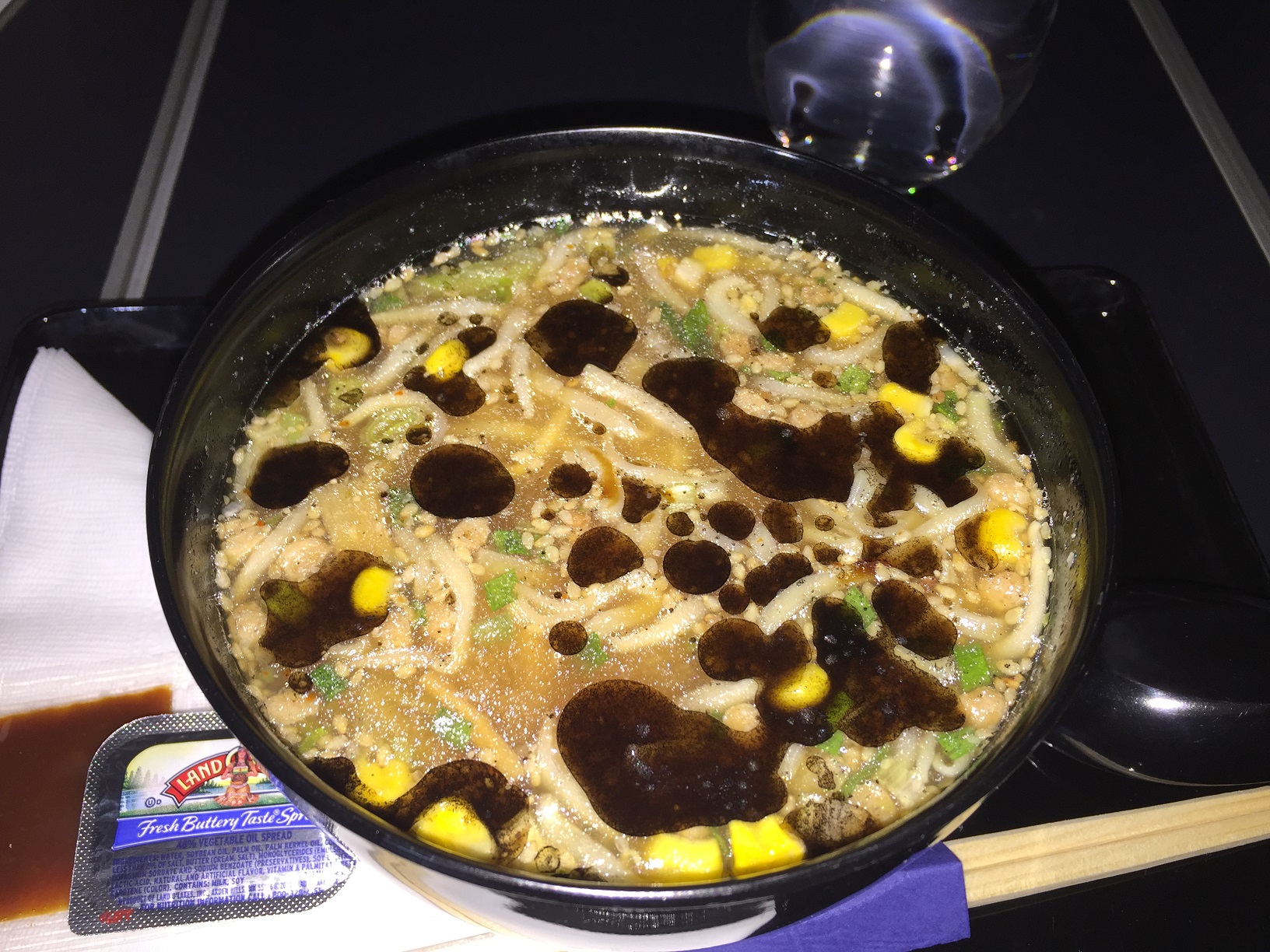
A couple of hours later, I was super hungry again. Ramen time — corn, scallions, ground pork, and a butter packet on the side. Sapporo-style miso butter corn vibes at 38,000 feet. The butter melts into the broth and gives it that creamy richness that makes you forget you’re in a metal tube somewhere over the Pacific.
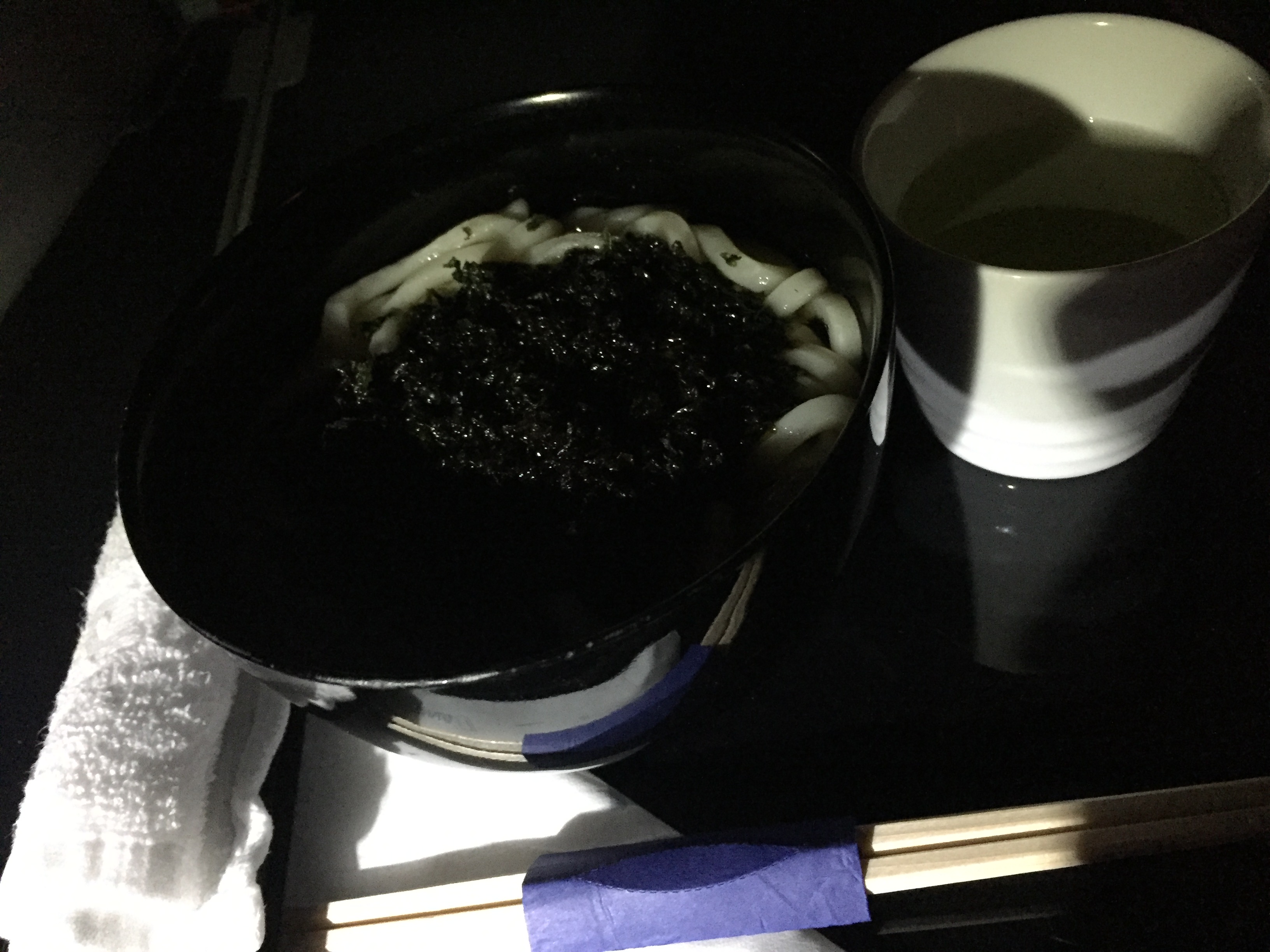
Still hungry. So I asked for one more — a bowl of udon with a generous mountain of nori, served with green tea. Hot, simple, perfect. By this point the cabin crew were probably wondering if I had a hollow leg. I was past caring.
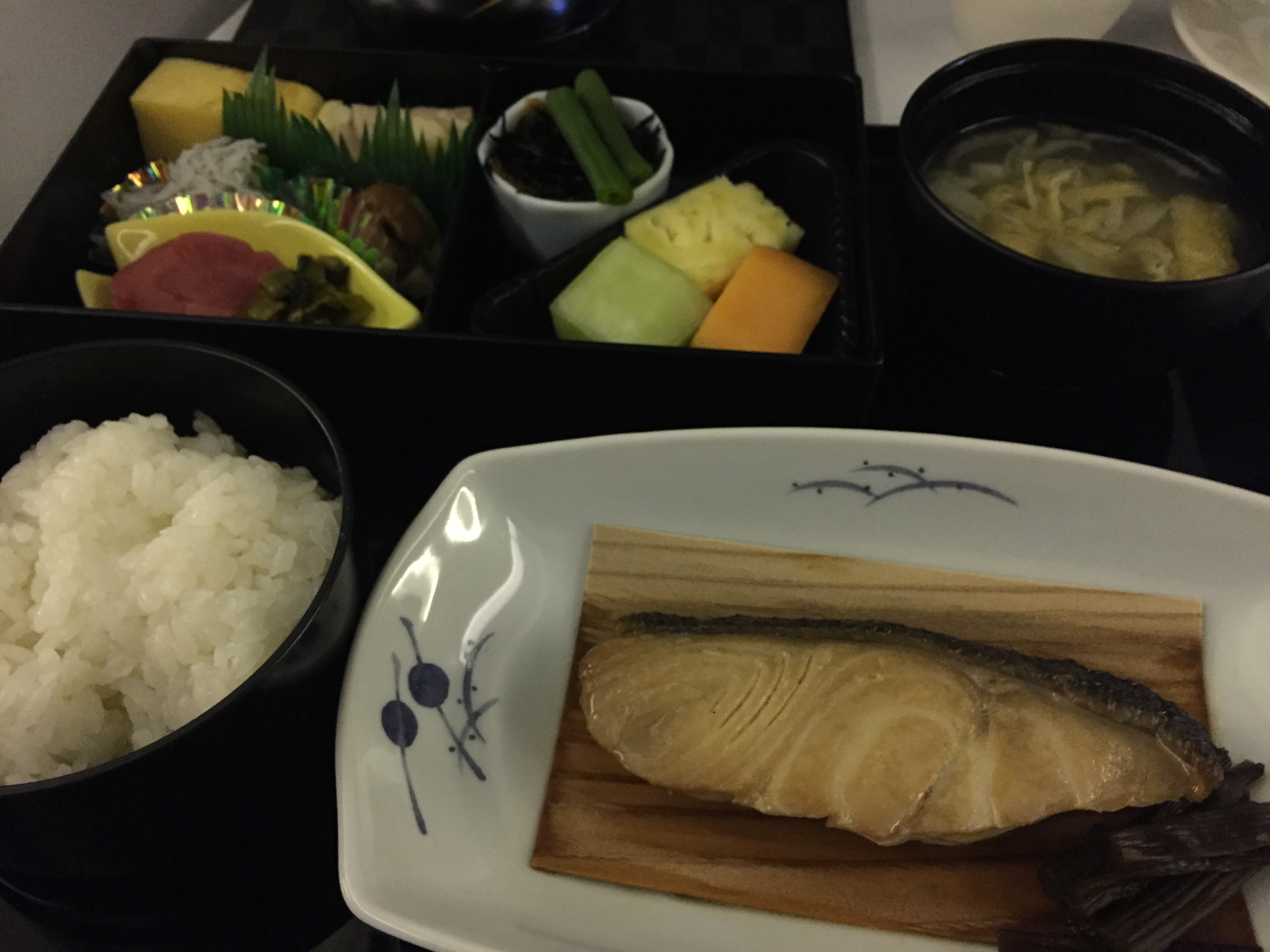
A few hours of sleep later, the cabin lights came up and breakfast appeared. A proper Japanese breakfast — grilled mackerel on a small wood plank, a bowl of rice, miso soup with mushrooms and bean sprouts, a slice of tamagoyaki, pickled vegetables, fruit, and a few simmered side bites. The fish was perfect: skin crisp, flesh just flaking. This is the kind of meal that signals you’re about to land in Tokyo.
Narita Transit and the Lounge
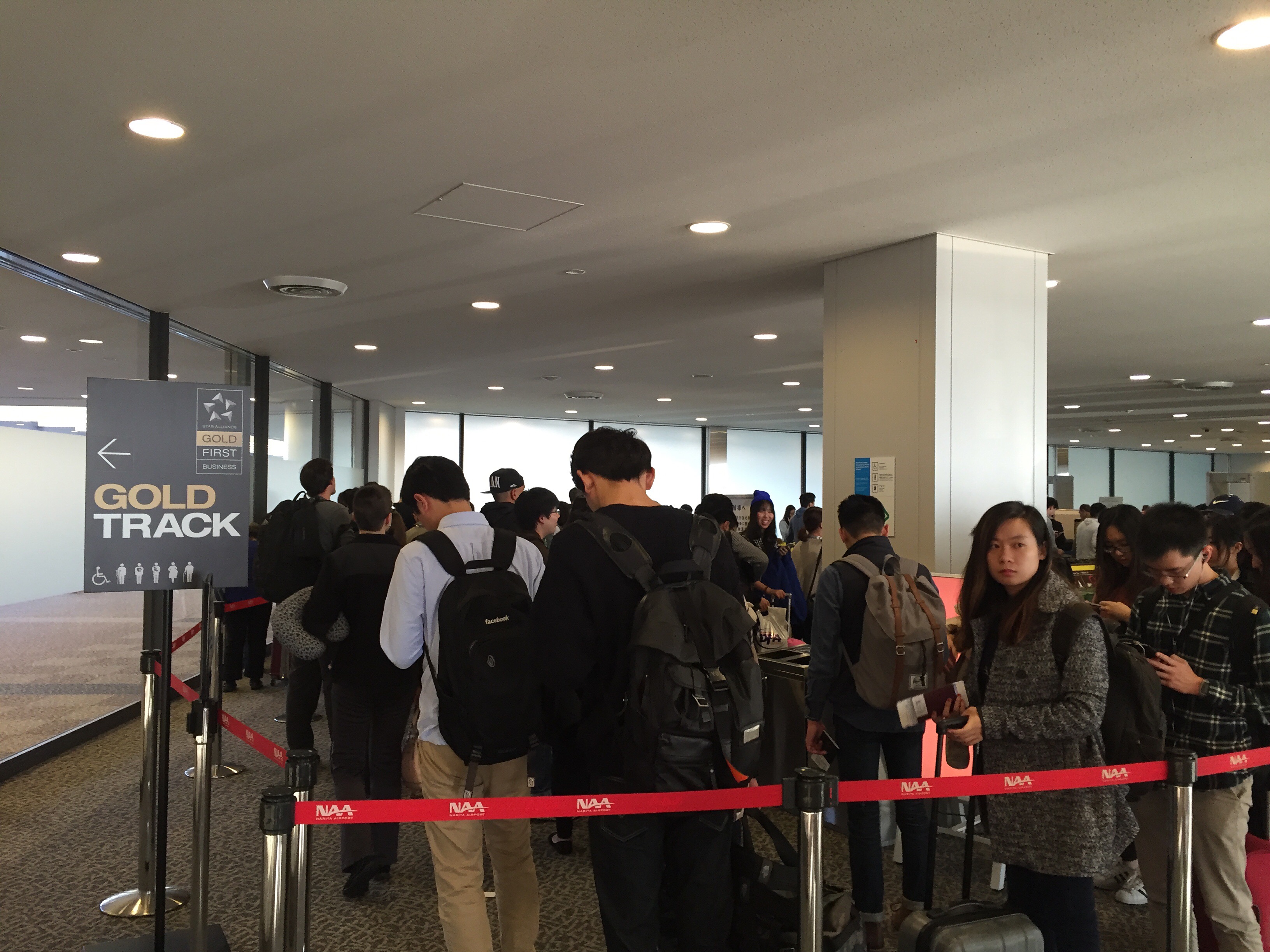
Narita was packed. Long lines at security snaking through the terminal. Thankfully business class gets the Gold Track priority lane, which let me bypass most of it. If you’ve ever transited through Narita without status, you know what a relief that is.
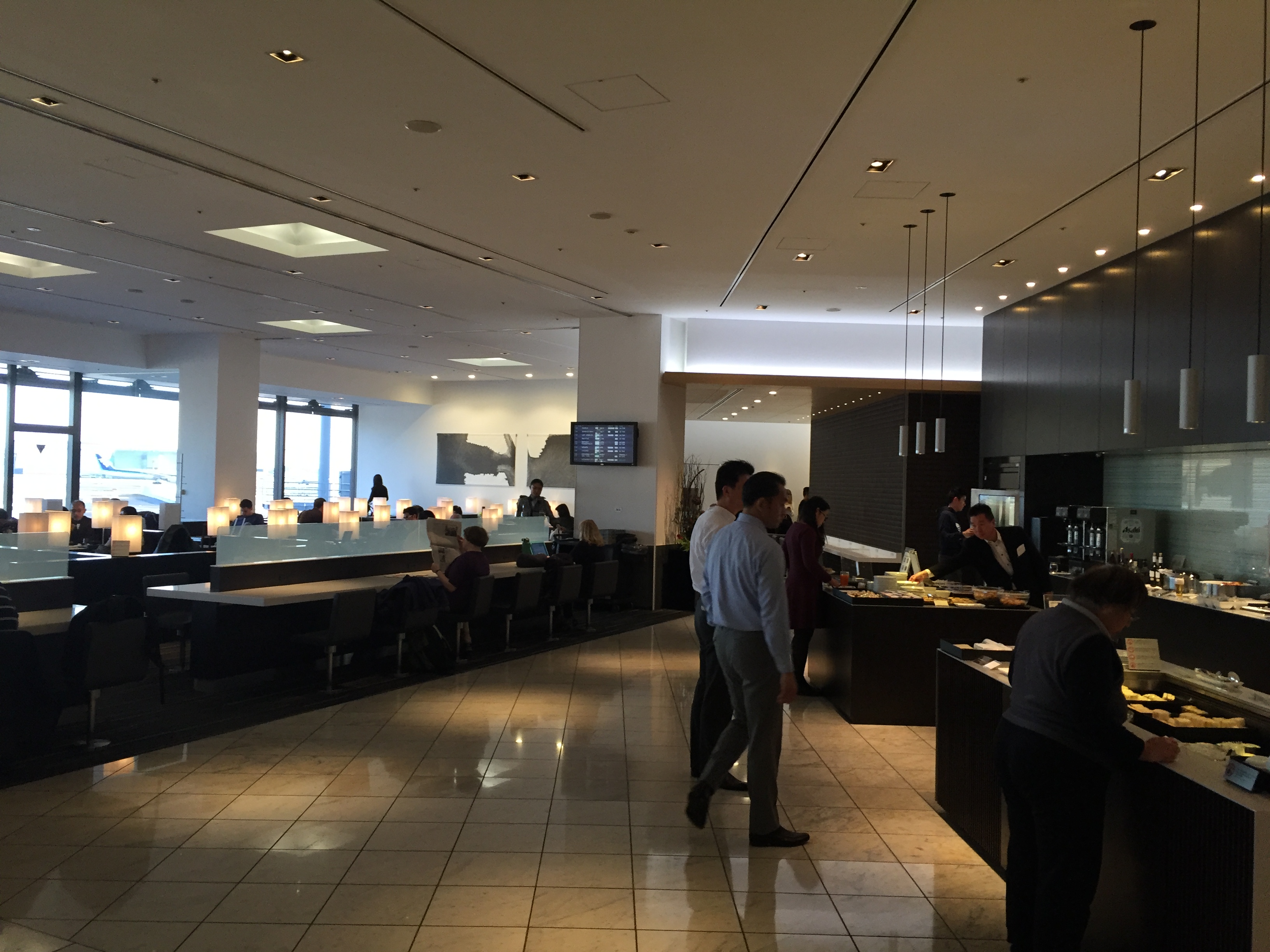
The ANA business lounge at Narita is one of the better business lounges in Asia — modern, well-lit, with runway views on one side and a serious food and drink program on the other. Plenty of seating, lots of natural materials, the kind of space that makes a long layover feel like a feature instead of a bug.
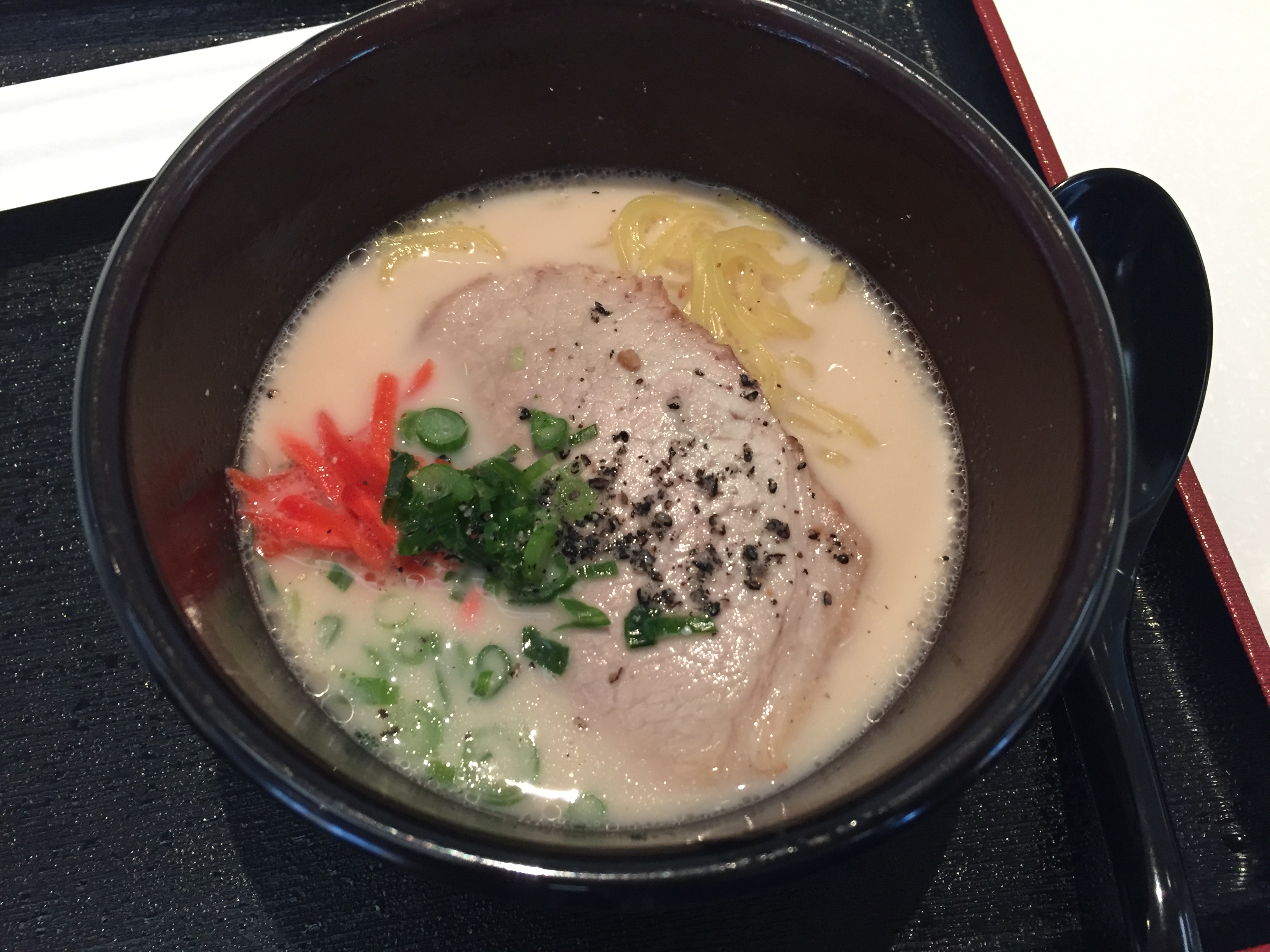
I went straight for the made-to-order tonkotsu ramen: proper creamy pork bone broth, a slice of chashu, scallions, and beni shoga. The kind of ramen most airline lounges don’t even attempt.
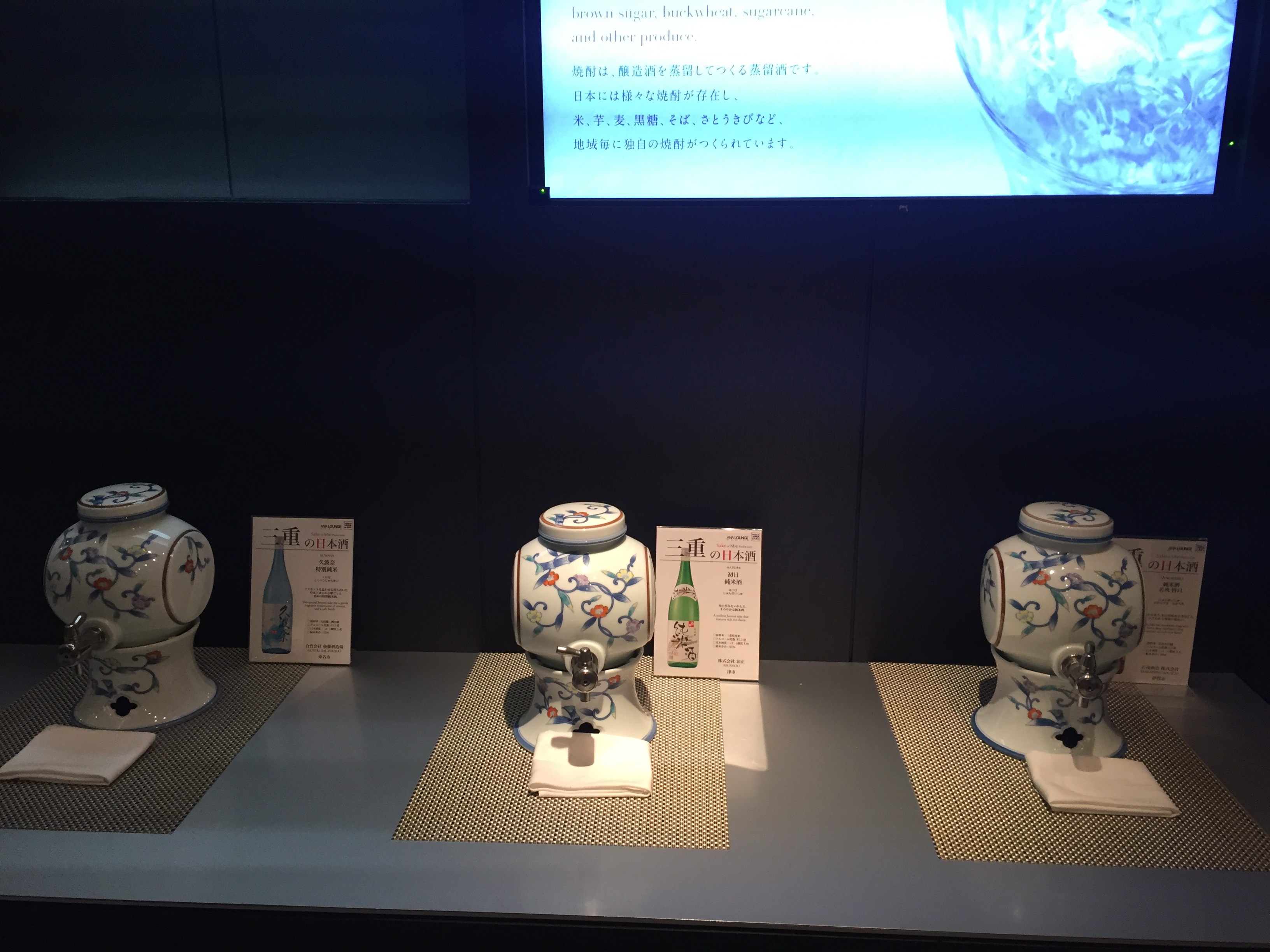
ANA also had a sake exhibition running in the lounge — three regional sakes from porcelain dispensers, each with information cards about the brewing region, and a video about brewing playing on the screen above. You serve yourself. A nice touch, and a good way to kill a layover.
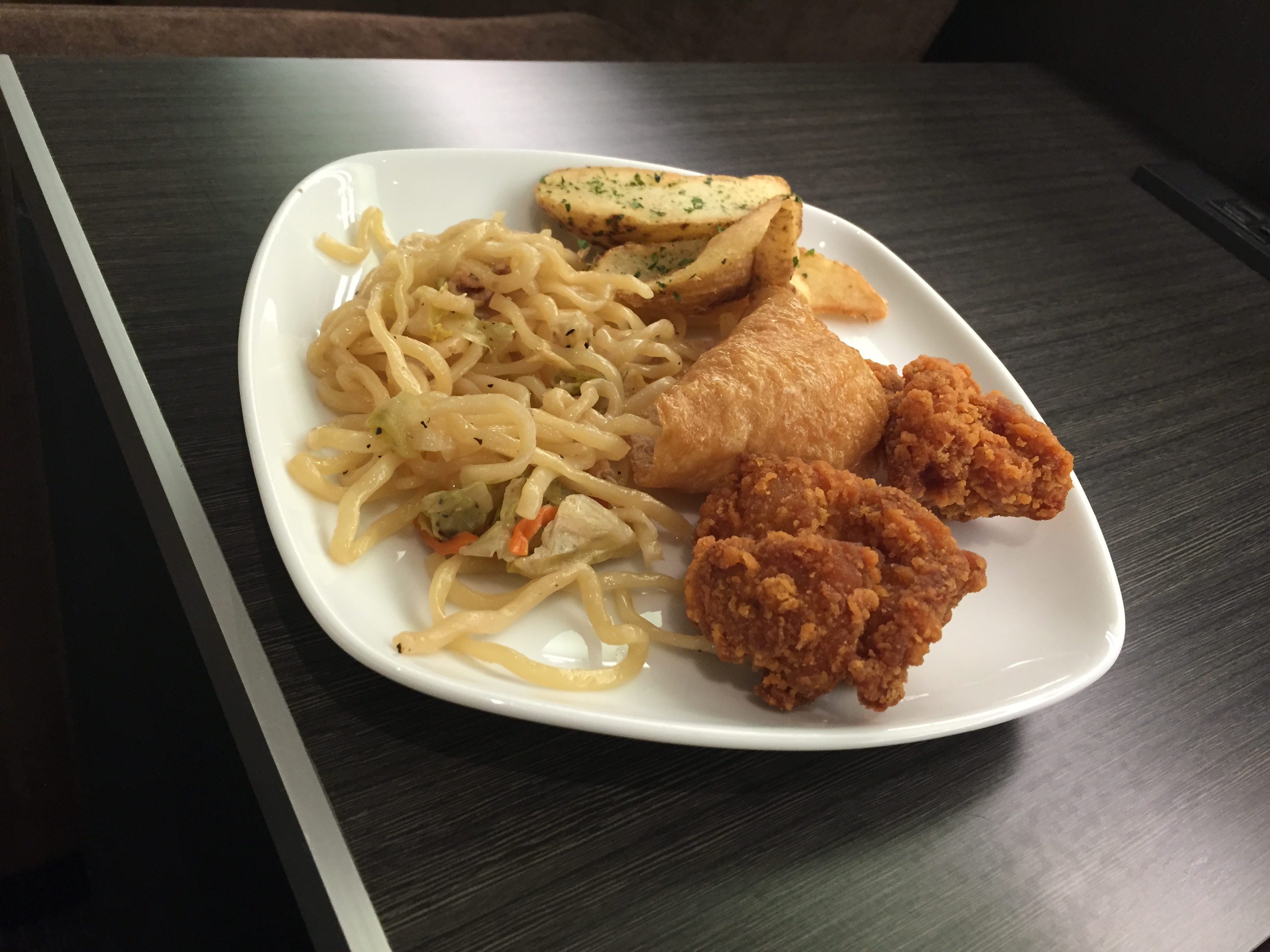
The buffet had karaage, gyoza, stir-fried noodles, and a dozen other things. I grabbed a plate, because at this point eating had become my hobby.
Second Flight: Narita to Jakarta
For the second leg I switched to the International menu, just to compare.
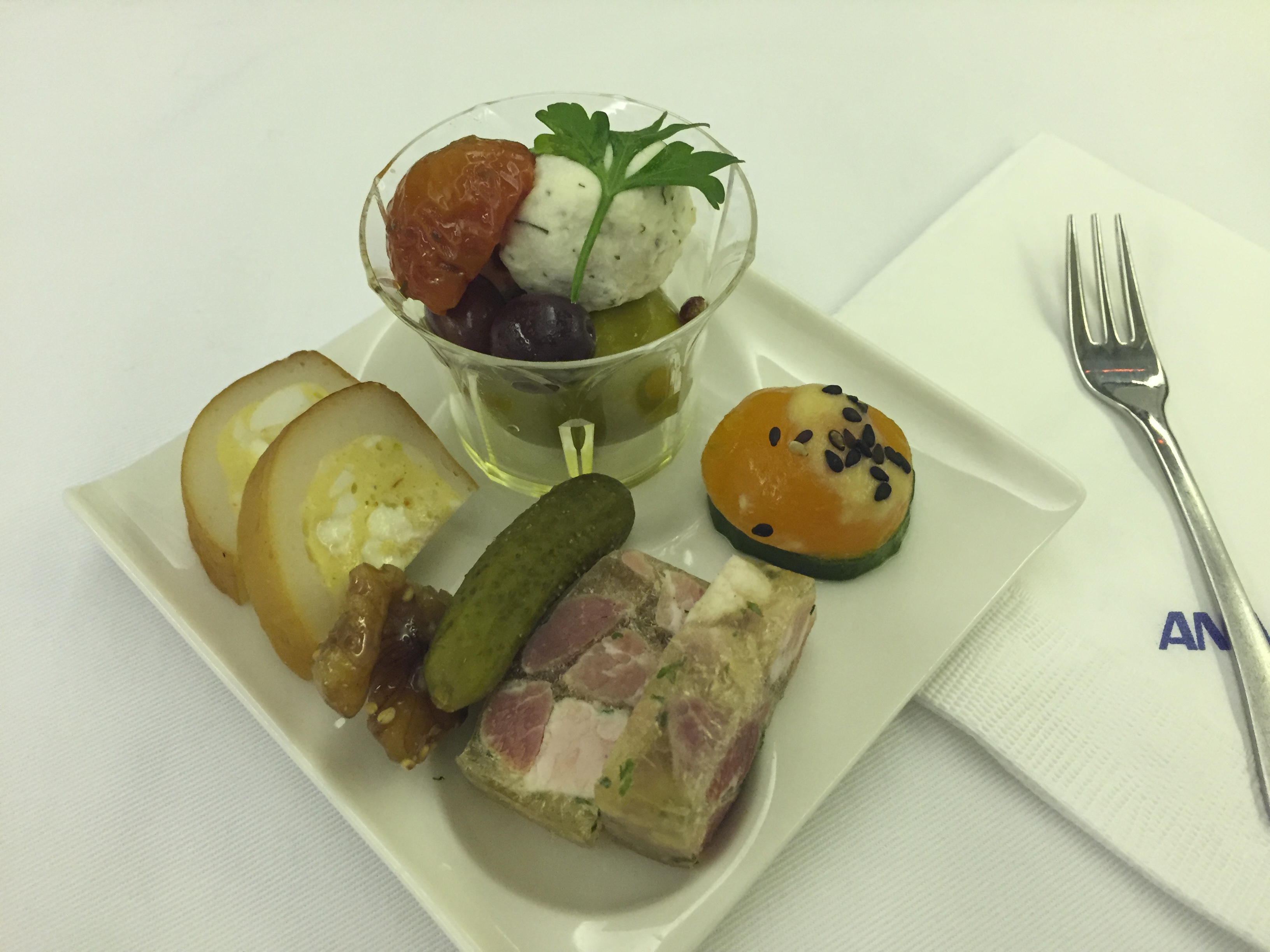
The international amuse — a pâté terrine with a cornichon, a mozzarella-and-tomato ball, mixed olives, a slice of brioche with foie gras, and a small sesame-topped mochi. More European in feel than the Japanese amuse — and very good in its own right.
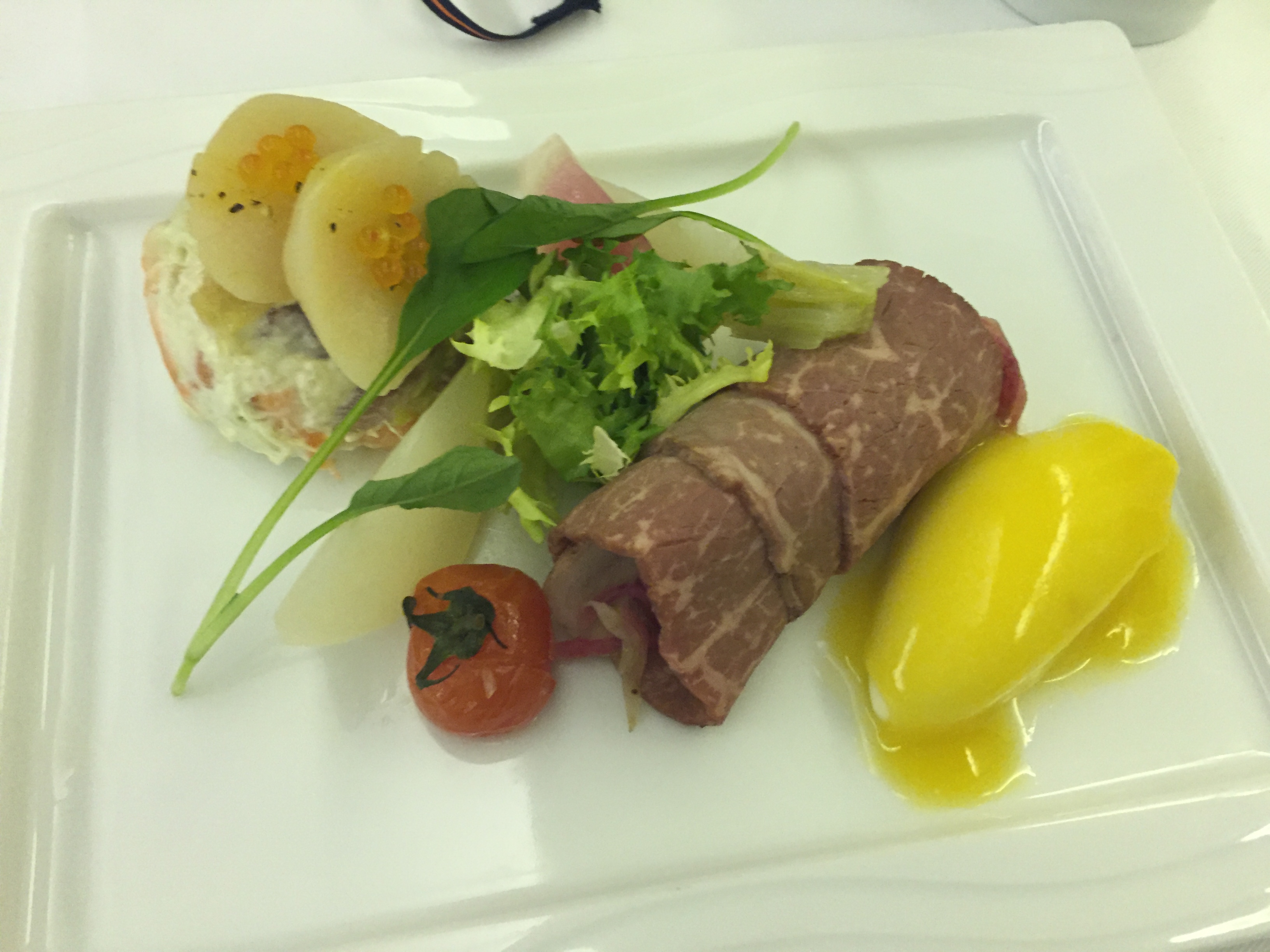
A beef roulade stuffed with vegetables, served with potato gratin, frisée salad, a small piece of salmon topped with ikura, and a quenelle of mango sorbet. The presentation was tight and the beef was actually tender — which is impressive for any in-flight protein, let alone after twelve hours of flight time.
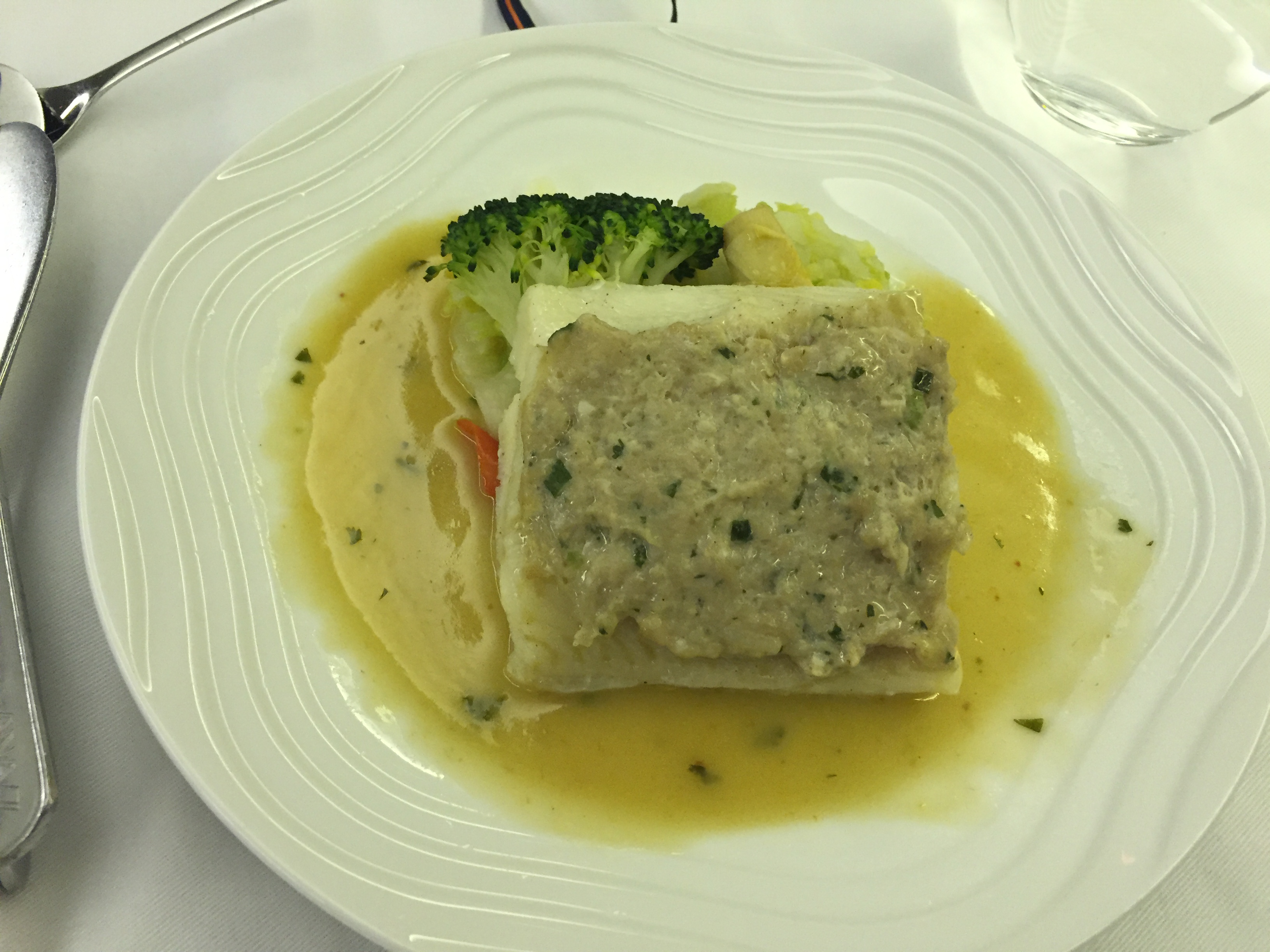
The fish course — a fillet with an herb-butter crust, broccoli, and a layer of pasta underneath. Lighter than the beef, and the sauce was actually well-balanced.
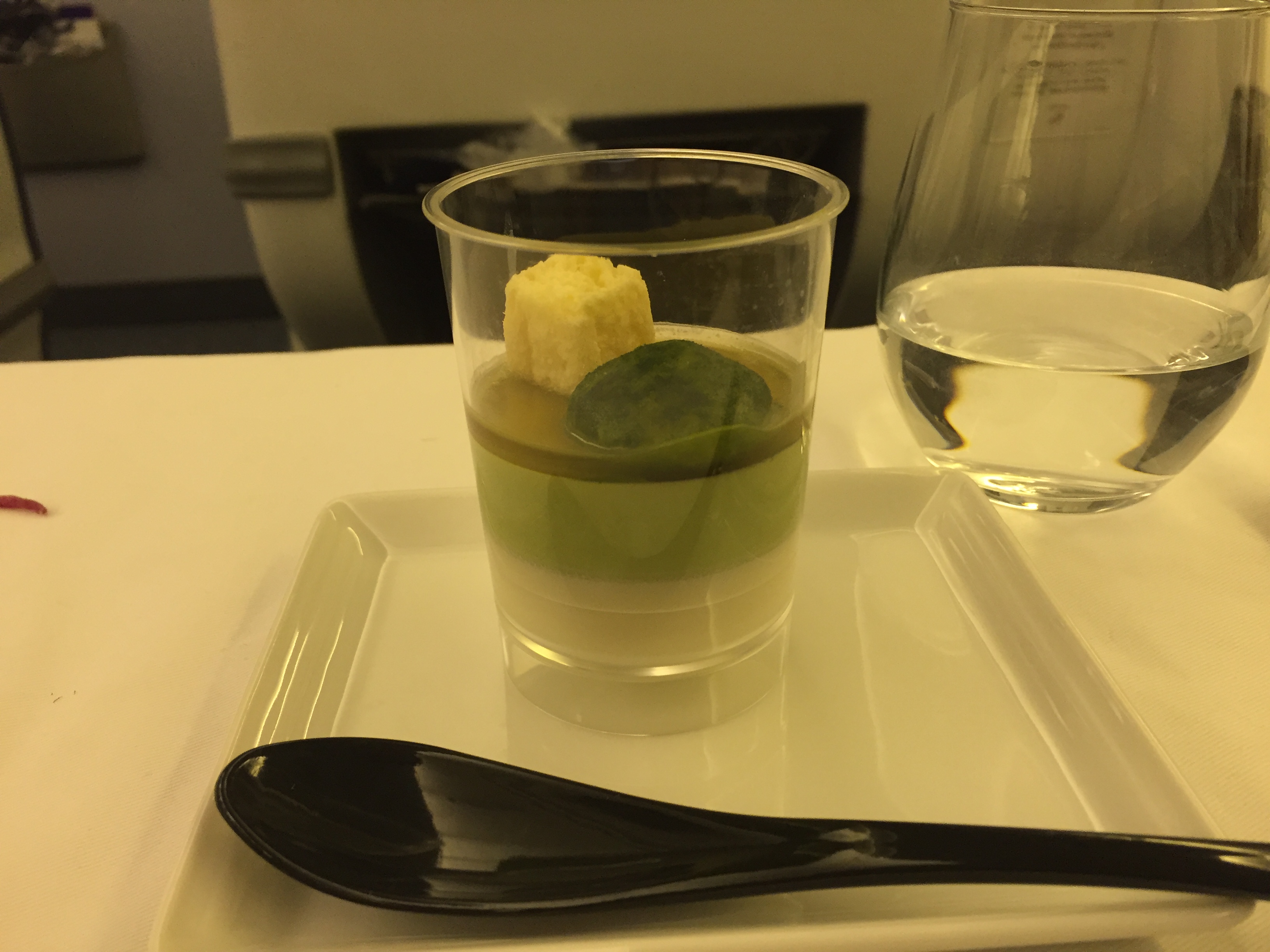
A clear yuzu jelly with a layer of green matcha cream, topped with a small mochi cube and a shiso leaf. Refreshing and clean — the right move after two heavy plates.
The Bottom Line
ANA business class isn’t a private suite, but the service, the food, and the small touches (the L’Occitane kit, the car magazine errand, the sake exhibition in the lounge) make it one of the best business class products in the sky.
The Japanese cuisine genuinely surprised me. I’ve eaten on a lot of airlines, and few do their home country’s food at this level. The international menu was solid, but the washoku felt like something a real kaiseki kitchen had thought about.
And if you ever see an award redemption where business costs fewer miles than economy, don’t think too hard about it. Just book it.